The Claws
Treble side? Bass side? You decide.
Jaguar pickups have teeth. There is a metal casing surrounding the pickups, and it has four longer and two shorter "teeth" underneath the strings.
There is a lot of confusion about the orginal design's intention – are the shorter teeth supposed to sit underneath the two treble strings (e-b) or underneath the two bass strings (a-e)?
With regards to the treble side there's the theory that back in the 60s string sets had wound g strings, so you'd get two plain strings and four wound strings, and lo and behold, this fits the 2 short and 4 longer teeth.
Plus, the reason for the longer teeth is supposedly to "focus" the magnetic field – so the area in which the vibrating string is "detected" by the pickup's magnet is narrower at the longer teeth - so the bass(ier) strings sound tighter, and the treble strings have a wider area and thus do not sound as harsh (see update below, in fact the intention was the other way round, the teeth should widen the area in wich the strings are 'seen' by the magnet).
Regarding the 'bass side' the theory is that the longer teeth enhance the magnetic field, giving the strings a little boost -- which is not neccessary with the two thickest strings. So the volume/output is more even across all strings.
Phew. I have not found any info anywhere if someone really A/B-ed the two orientations. And if there really is an audible difference.
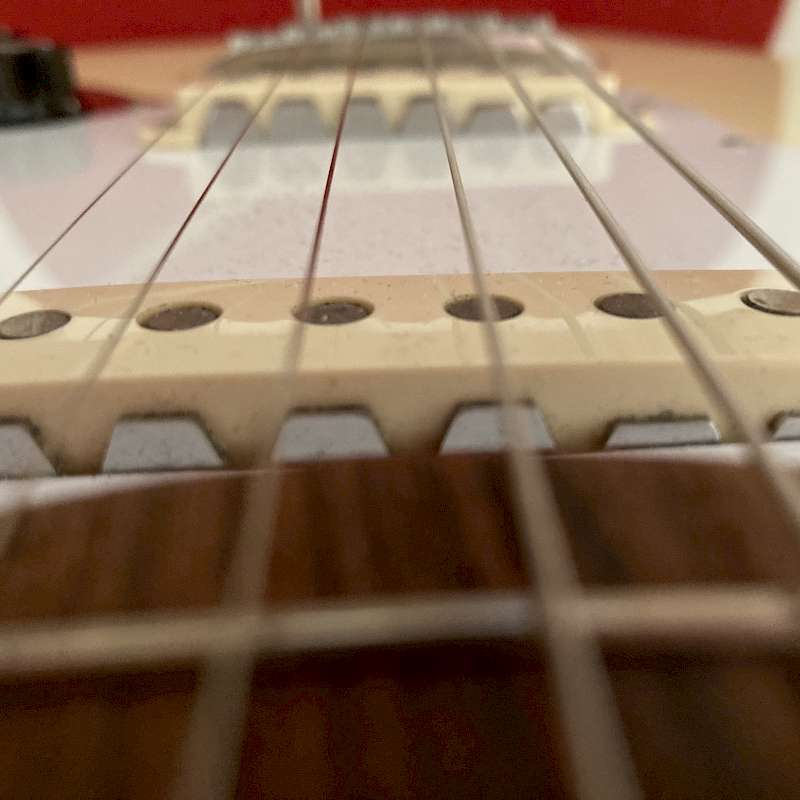
I compared four Jaguars from different eras: A 1963, a 2001 AVRI, a 2002 CIJ, and finally a 2012 Johnny Marr Signature model. Guess what, there's a 50:50 distribution in that enormous sample.
The 1963 and the 2012 Marr have the shorter teeth underneath the bass strings:

The 2001 AVRI and the CIJ have the shorter teeth underneath the treble strings:
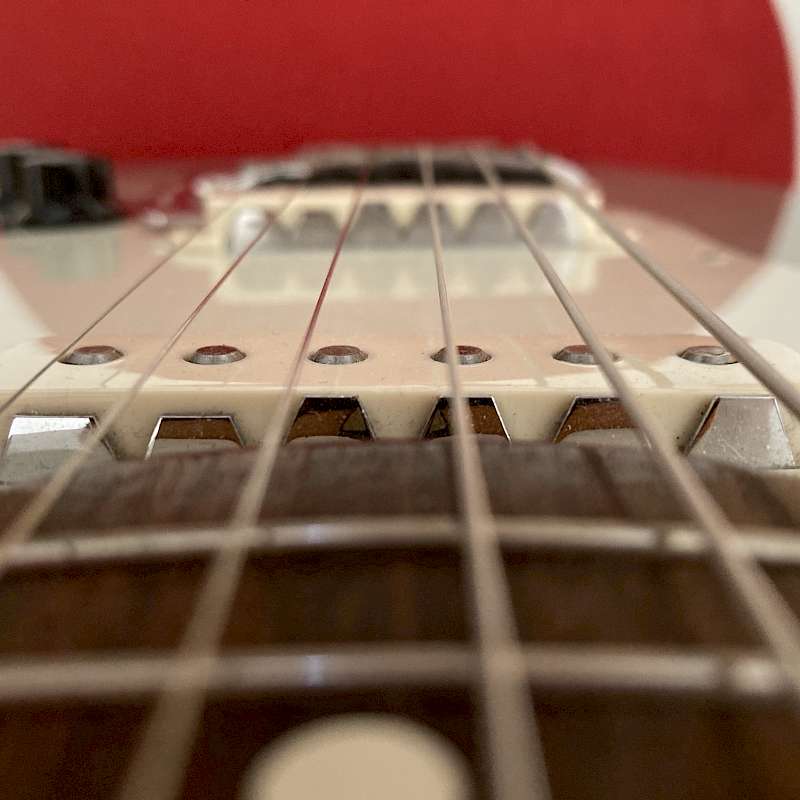

Now, this is by far no representative sample, but it strikes me as odd that the AVRI has the shorter teeth underneath the treble side.
The CIJ might have been trough a pickup change, but I'm fairly certain that the other three are in their factory-mounted state.
Assuming that the Marr model is modelled after his favorite 1965 jaguar, and that the one from 1963 also has the shorter teeth underneath the bass strings, maybe this is the original design?
But if the AVRI is true to the claim of being a true replica of the 1962 model - how come the claws are on the treble side?
According to a 1969 Fender manual, the short teeth belong under the treble strings, but this again has been disputed by claims that the majority of vintage Jags have the shorter teeth under the bass strings.
This remains a mystery and ongoing discussion.
UPDATE (2026/02)
The patent (US3236930) for this pick up is very interesting in regard to the teeth. It describes their function and in the drawings all teeth have the same height.
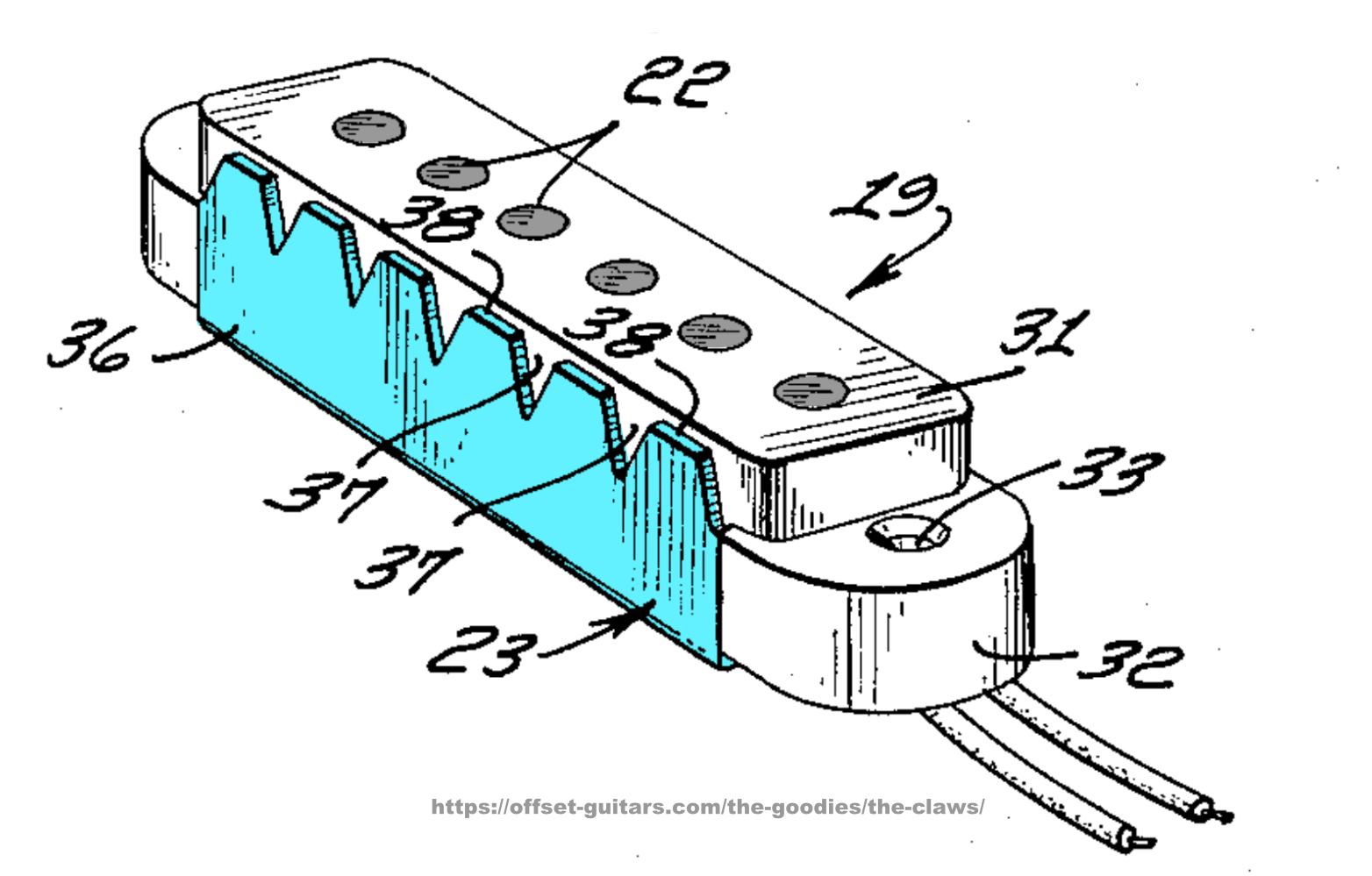
There is a certain relationship between the length of the magnet in the pickup and the distance of the tooth and the distance to the string:
(…) It is emphasized that the entire pickup (19) is disposed on only one side of the common plane of strings (12), all portions of the pickup being spaced from such common plane a sufficient distance that here will be no substantial interference with playing of the instrument.
It is important to the invention that the spacing between the pickup and the plane of strings (12), the distance longitudinally of the instrument between each magnet (22) and the two associated teeth (38), and the lengths of the magnets (22), be correlated to each other in a certain manner.
As will next be described, the manner of correlation is such that at least a large number of the lines of magnetic force will, when traveling between the upper ends of the magnets and the adjacent teeth, pass longitudinally through substantial portions of the associated strings (12). (…)
Fender's intention was to 'capture' as much movement of the vibrating string, both in vertical and horizontal direction.
(…) Another object is to provide a pickup which is relatively insensitive to rotation of the plane of vibration of the vibrating string, so that a relatively smooth and uniform sound is generated (…)
The teeth bring 'up' the opposite magnetic pole, so that the 'arc' of the magnetic field is formed in a way that a larger part of the string 'is seated' in that field. Fender describes this as a "double magnet":
(…) The term "double magnet” is employed since the teeth may be regarded, in the illustrated example, as south poles to which the lines of force extend (via string 12) from the north pole therebetween. (…)
There is an illustration in the patent showing the idea:
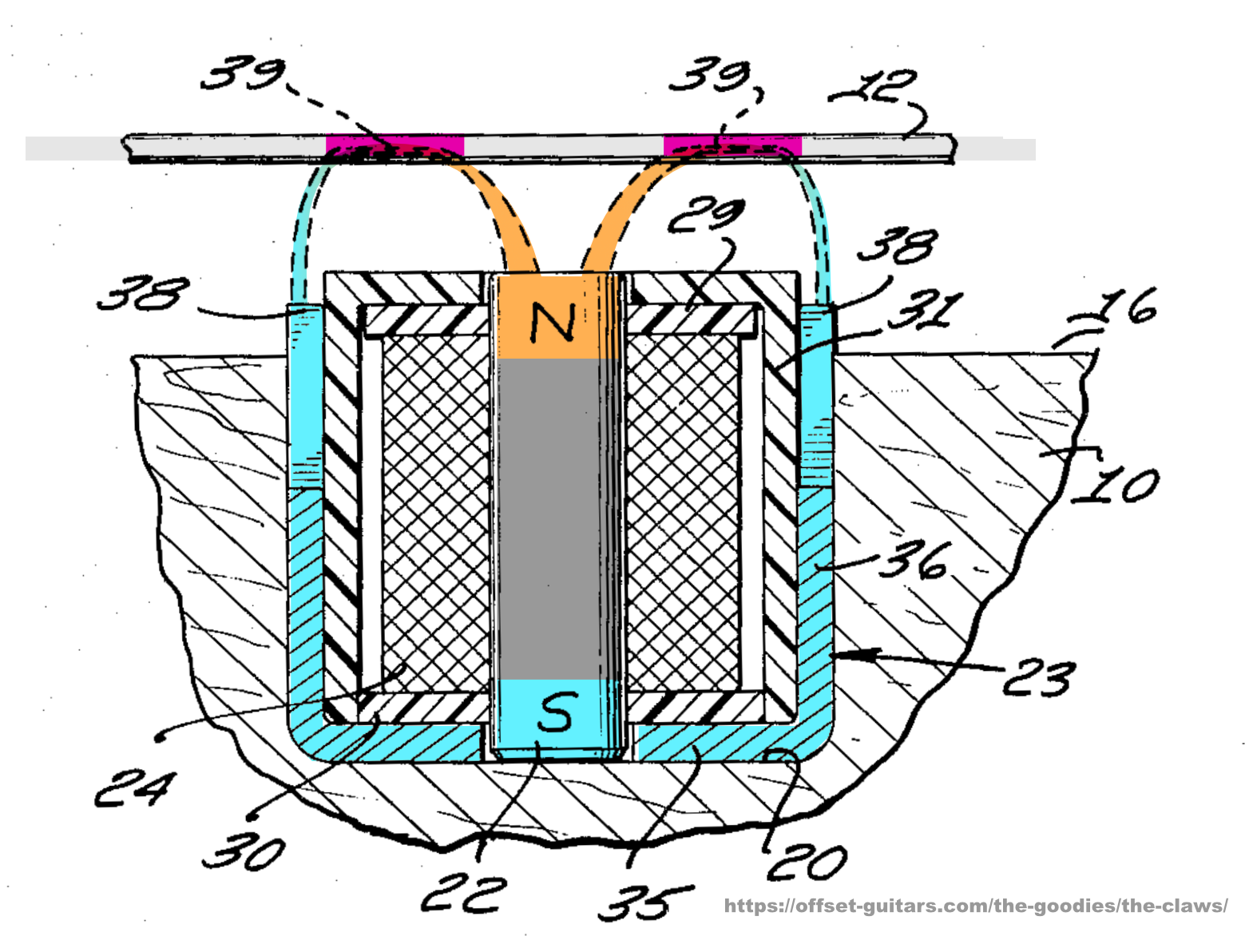
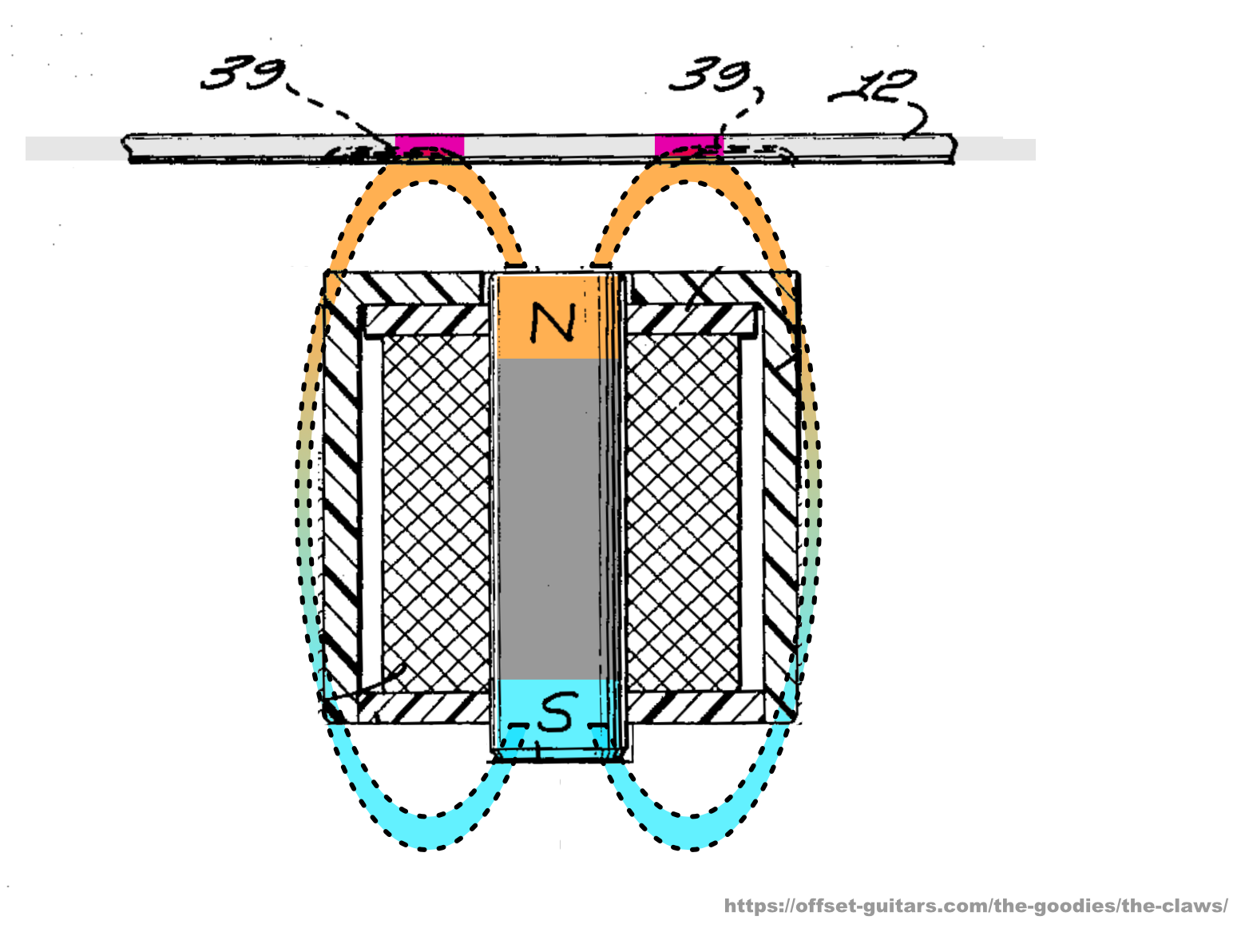
Now, by lowering the teeth a bit, the 'arc' will be not as broad, so a smaller part of the string will be seated in there. It is my understanding that this will slightly reduce the voltage and current induced by the string movement.
(…) A further object is to provide a pickup which is highly Superior in its ability to respond to bass vibrations (…)
The triangular shape of the teeth is intentional, the narrow tip is meant to 'shape' the magnetic field to be more focussed under the string.
(…) The provision of the notches (37) and asociated teeth (38) is also important to the forcing of the lines of force through strings (12). If the upper edges of the flanges (36) were merely straight, the lines of force from the various poles would fan out to various undetermined positions along such edges, which would reduce the tendency of the lines of force to pass through the strings (12). Since the upper flange eges are formed with teeth, all of such teeth are of the same polarity (for example south in the present illustration). The teeth being of the same polarity, they repel each other and cause the lines of force to bunch or hump until large numbers therof pass through the strings. (…)
The tip of the lowered teeth is a bit broader – this could also be a pointer that they were meant for the bass strings which will vibrate more.
So I think maybe the intention of the shorter teeth was to even out the output of the thicker bass strings (E, A ) in comparison to the 'weaker' (D,G,B,E) strings.
Maybe having the teeth at the bass strings worked too well and over-emphazised the bass, so Fender tamed that a bit by lowering the teeth on the bass strings.
So the mystery is no longer what the Intention was but why the Fender Jaguar Manual from 1969 is showing the teeth underneath the treble strings - a CBS lapse? :-)
And why have the "era correct" AVRI models from 1999/2000 he teeth under the treble strings?
And ultimately; does it really make a noticable difference? In theory having the lower teeth under the treble strings should result in a bass-ier sound. Which maybe preferrable to some. Shorter teeth under the bass strings should make it less bass-ier - which may add some bite to the sound.
But really, considering other factors like string height, string gauge, playing attack and EQing - maybe this teeth thing is not so important. :-)
If you want to follow a deep-dive into the physics, I highly recomment the chapter "5.4.7" in M. Zollner's book "The Physics of the Electric Guitar", which is available as PDFs in an english translation. The original German version is available in print (thanks to Timtam in the Offset-Guitar forum for the info and the link).